
The method: how a business becomes AI-native.
Most AI projects start with prompts and work up. We start with how your business works and work down: five layers, then a loop that makes it improve. The same method sits behind both ways in, whether we are changing how the business runs or building an AI product.
You speak to the senior lead who would do the work. If we are not the right fit, we will say so.
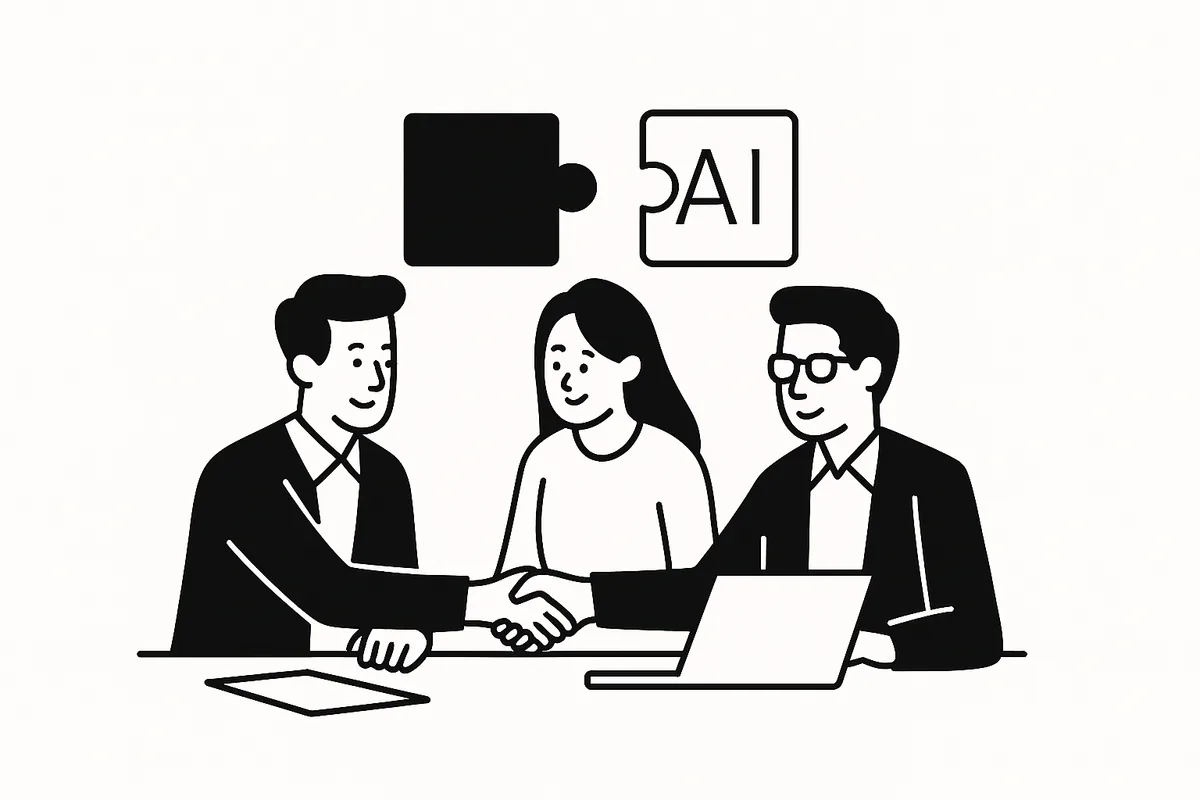
Most AI projects start with prompts. We start with how your business works.
Five layers, worked from the top down. Each one makes the next one cheap to get right, and the last step feeds back into the first.
Map the workGraph engineering
A living map of how work flows: every step, decision, hand-off and owner. You see where AI belongs, and where it does not.
Close the loopsLoop engineering
Every process gets a measure and a feedback cycle, so you know whether a change helped, not just that it shipped.
Build the harnessHarness engineering
Agents with the right tools and permissions, plus spend caps, an off switch, evals and a human sign-off. Safe to switch on.
Feed it your knowledgeContext engineering
Your documents, data and decisions, structured so the AI knows your business, not the internet’s.
Tune the instructionsPrompt engineering
The last mile, and the cheapest to change. It goes last because it is easy to get right once the four layers above it exist.
Then it improves itselfRecursive self-improvement
What each loop learns updates the map, so every cycle the business runs a little better, with or without us.
The first 90 days
A map and a plan in 2 weeks. The first AI-run process or feature live by week 6. Your team running the loop by week 12.
1. Weeks 1–2
Embed
Map the work
A senior lead joins your standups and decisions, maps how the work actually flows, and writes the plan and the cost.
You have: A map of how work flows, and a plan and cost you can defend.
2. Weeks 3–6
Equip
Close the loops · Build the harness · Feed it your knowledge · Tune the instructions
We put measures and feedback on the work, build the agents with guardrails and spend caps, give them your knowledge, and put the first one live.
You have: Your first AI-run process or feature, live, measured and capped.
3. Weeks 7–12
Hand over
Then it improves itself
Your people are trained as we build and take over the loop. The map, the code, the data and the playbook are already in your accounts.
You have: A team that runs the loop without us, and the next cycle planned.
What each layer leaves you with
Every layer ends with something you can open and inspect, in your own accounts.
1. Map the work
Graph engineering
In your operations: A process map of, say, order to invoice: every step, who owns it, where it waits, and which steps are repeated work an agent could take.
In your product: The agent workflow as named steps and allowed paths, plus how your team ships: intent, spec, build, review, release.
2. Close the loops
Loop engineering
In your operations: One number per process (cycle time, error rate or cost per case) with a weekly review that decides what changes next.
In your product: Evals on every change, and production signals that feed straight into the next spec.
3. Build the harness
Harness engineering
In your operations: An agent register: every automation, its owner, its permissions, its spend cap and its off switch. A person signs off anything that reaches a customer.
In your product: Tools, memory, permissions, logging and retries around the model, and review rules for AI-written code.
4. Feed it your knowledge
Context engineering
In your operations: Your SOPs, policies, price lists and past decisions, cleaned up and structured so an agent can find the right one.
In your product: Retrieval over your own data, with exact-term search where it matters, such as part numbers and names.
5. Tune the instructions
Prompt engineering
In your operations: Instructions for each step, versioned, with examples taken from your own work.
In your product: Prompts treated as code: versioned, tested against the evals, and changed through review.
↻ Then it improves itself
Recursive self-improvement
In your operations: Every week, read the measures and update the map. Every month, retire, merge or add an agent.
In your product: Every release, eval results and production signals update the workflow, the context and the instructions.
Why teams pick us
We work inside your team, not beside it. We stay with you and build the thing, so the plan actually happens.
- Month to month: we have to keep earning it
- Month to month, with no minimum term. Stop any month. The code, data, playbooks and tools are already in your accounts, so you keep everything built so far.
- Senior people only
- You work directly with the engineers who design and ship the system. No account layer, and no handoff to a junior team once the work starts.
- Sized for your business
- Everything we do is shaped for startups and small or mid-sized companies, not copied from an enterprise playbook. No inflated AI promises, just an honest view of what will move the business and what will not.
- Software your team can still understand
- AI writes code faster than any team can read it. So everything we build with AI also gets a human review, proper testing, and plain notes on why it works the way it does. You end up owning software your team can run, not a mystery box.
Make your business AI-native, starting this month.
You speak to the senior lead who would do the work. If we are not the right fit, we will say so.